Beyond the Bling: How Technology and Personal Stories Are Redefining Jewellery Design
What if a piece of jewellery could tell your story without saying a single word?
A ring inspired by a childhood memory, a pendant featuring a meaningful symbol, or earrings that combine traditional craftsmanship with modern shapes can feel more personal than an ordinary accessory. Today, jewellery design is moving beyond decoration. It is becoming a creative way to express identity, emotions, and individuality.
At the same time, technology is changing how designers turn ideas into finished pieces. From digital modelling to customised designs, the industry offers exciting possibilities for people who enjoy art, fashion, and detailed craftsmanship.
Why Personalised Jewellery Is Gaining Attention
One noticeable trend is the growing interest in jewellery that feels personal. Instead of choosing designs simply because they are fashionable, many buyers look for pieces that reflect their personality, relationships, or memories. Recent jewellery coverage has highlighted personalisation, meaningful motifs, and versatile styling as important influences on modern collections. <Cite refs={[“turn565948search3″,”turn565948search6”]}/>
This shift gives designers an interesting challenge: how can they turn someone’s story into a beautiful, wearable object?
For example, a designer might create a pendant inspired by a favourite flower or develop a ring using a meaningful shape. Initials, birthstones, engraved messages, and symbolic details can also give a piece a unique identity.
However, personalisation does not always mean adding more decoration. Sometimes, a simple design with one thoughtful detail communicates an idea more effectively.
For aspiring designers, this trend highlights the importance of understanding people, asking the right questions, and translating emotions into visual concepts.
From Sketchbook to Screen: Technology Meets Craftsmanship
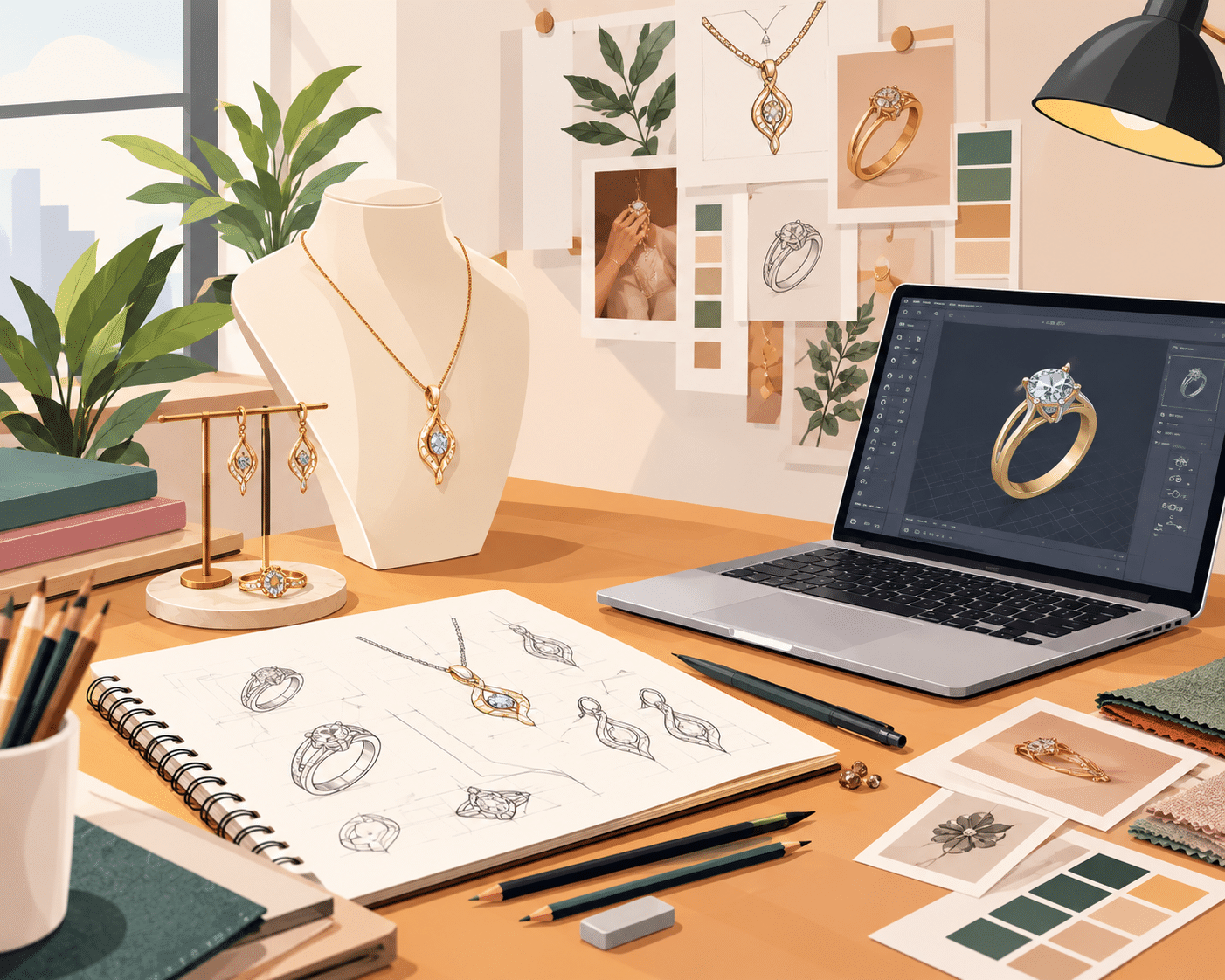
Jewellery design has traditionally involved drawing, studying materials, and understanding how individual components fit together. These skills remain important, but digital tools have expanded the creative process.
Computer-aided design (CAD) software allows designers to develop detailed three-dimensional models. They can examine proportions, explore different settings, and adjust a design before it moves into production.
Digital rendering can also help show how a piece might look with different materials or gemstones. In suitable workflows, 3D printing supports the creation of prototypes, making it easier to review shapes and dimensions before manufacturing. <Cite refs={[“turn565948search5″,”turn565948search7”]}/>
Artificial intelligence can provide another source of inspiration. Designers may use AI tools to explore visual directions, generate reference concepts, or experiment with different combinations of shapes and textures.
Still, technology cannot replace every part of the creative process. A digital image does not automatically account for comfort, durability, stone security, material limitations, or the skill required to manufacture a piece.
The strongest results come when designers combine digital experimentation with sound design judgement and practical craftsmanship.
Why Traditional Craft Is Still Relevant
While technology creates new possibilities, traditional craftsmanship continues to influence contemporary jewellery.
Indian techniques such as meenakari, jadau, and filigree offer distinctive approaches to colour, surface detail, metalwork, and ornamentation. Designers can study these traditions and explore ways to adapt their visual qualities for modern collections. Recent coverage of Indian jewellery trends has also highlighted renewed interest in regional craft and heritage-inspired designs. <Cite refs={[“turn565948news23″,”turn565948search4”]}/>
Imagine a traditional floral motif reinterpreted as a minimal pendant. Alternatively, a detailed heritage pattern could inspire the surface of a contemporary bracelet.
The aim is not simply to copy an existing design. Instead, designers can understand the technique, appreciate its cultural background, and develop a fresh concept that respects its origins.
This combination of heritage and innovation can give jewellery a distinctive identity.
Sustainable Thinking Starts With Better Design
Another important consideration is how jewellery is designed and produced responsibly.
Material selection, efficient production, repairability, and thoughtful use of resources can all influence a piece’s overall impact. Digital modelling may also help designers review certain details before production, potentially reducing avoidable prototypes and material waste.
Nevertheless, sustainability depends on the complete process, including material sourcing, manufacturing, durability, and the life of the finished product.
Designers can contribute by considering these factors early rather than treating them as an afterthought.
For students, this means learning to ask practical questions alongside creative ones. Is the design comfortable to wear? Can the piece be repaired? Are the materials suitable for its intended use? Could the structure be simplified without losing its character?
These decisions demonstrate that good jewellery design requires both imagination and responsibility.
How Can You Begin Learning Jewellery Design?
You do not need to start with an elaborate necklace or a complicated gemstone setting. A simple sketch can be enough to begin.
Start by observing jewellery around you. Notice the shapes, proportions, textures, clasps, and ways different materials work together. Collect references, practise drawing, and experiment with variations of the same design.
Next, try developing a small collection around one idea. For example, you could create three pendant concepts inspired by nature, architecture, or geometric forms. Explain what makes each design different and consider who might wear it.
As your skills develop, explore materials, technical drawings, digital tools, and the practical requirements of making jewellery.
Students considering a jewellery design course in Indore can look for a learning environment that balances creative exploration with practical projects, technical understanding, guidance, and portfolio development.
At KID – Krishna Institute of Design, students can explore creative ideas and build their design abilities through guided learning and project work. Reviewing the curriculum and available facilities can help prospective students understand how a programme matches their interests.
A portfolio is especially useful because it can show more than finished designs. It can also demonstrate sketches, research, experiments, and the thinking behind creative decisions.
The Future Belongs to Designers Who Keep Exploring
Jewellery design is evolving through a combination of personal expression, traditional craftsmanship, digital tools, and changing expectations.
Yet the central challenge remains the same: creating something people want to wear, value, and connect with.
Technology can help develop an idea, but thoughtful design gives it purpose. Traditional techniques can provide inspiration, while experimentation helps transform that inspiration into something new.
For anyone interested in this field, the best starting point is curiosity. Observe carefully, practise regularly, learn from mistakes, and remain open to different materials and methods.
The future of jewellery design is not simply about making pieces that shine. It is about creating designs that carry meaning, reflect individuality, and bring imagination into the real world.