How AI Is Changing Game Development and Design
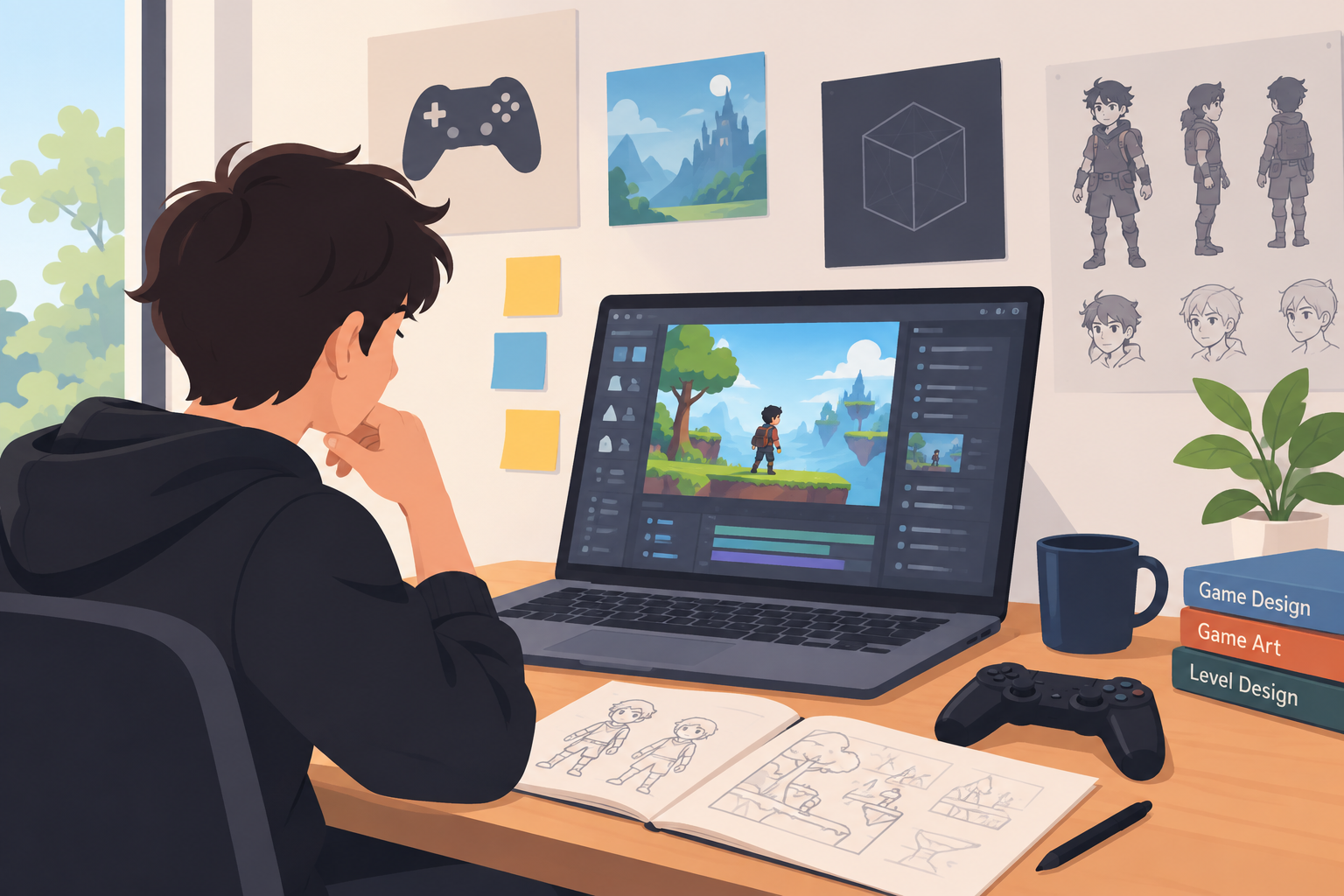
Imagine creating a game where characters respond more naturally, environments can be developed faster, and repetitive tasks take less time than before. This is no longer just an idea from science fiction. Artificial intelligence is becoming an increasingly important part of the game development process.
For students interested in game design, this change can feel exciting but also confusing. Does AI mean fewer opportunities for creative people? Do students still need to learn traditional design and development skills? The answer begins with understanding what AI can actually do and where human creativity remains essential.
What Is AI Doing in Game Development?
Game development involves many different tasks. Developers work with code, artists create visual assets, designers build gameplay systems, writers develop stories, and sound professionals create audio experiences.
AI can assist with some of these tasks.
For example, AI tools can help developers generate ideas, identify coding problems, create early visual concepts, organise large amounts of information, or automate repetitive processes. Instead of spending hours on certain routine tasks, a developer may be able to use technology to create a starting point and then improve it manually.
This does not mean an entire game can simply be created by pressing a button.
A successful game still requires planning, testing, creative direction, technical decisions, and human judgement.
AI Can Speed Up the Creative Process
One of the biggest advantages of AI is speed.
Imagine a game designer needs ideas for ten different fantasy environments. Instead of creating every concept from the beginning, AI-assisted tools can help generate rough visual directions.
These early concepts can then be reviewed and changed.
Perhaps one environment has the right atmosphere but the wrong architecture. Another may have interesting colours but does not match the game’s story. The designer can select useful elements, modify them, and develop the final concept.
This makes AI more useful as a creative assistant than as a replacement for the designer.
What About Game Characters?
Characters are another area where technology can assist development.
AI can help developers explore character concepts, dialogue possibilities, behaviours, and different interactions. In games with complex worlds, developers may also use technology to create characters that respond differently depending on what players do.
For students, this demonstrates an important point: game design is not only about creating attractive characters.
A character needs personality, purpose, behaviour, and a connection to the game’s world.
Human creative thinking is still needed to decide what the character should represent and how players should experience that character.
AI and Game Art
Creating game environments can involve enormous amounts of visual work.
Artists may need to design buildings, landscapes, objects, textures, characters, interfaces, and other assets. AI-assisted tools can help generate references, explore variations, or speed up parts of the concept development process.
However, generated content may not always be consistent.
A character might look different from one image to another. An environment may contain details that do not make sense within the game’s world. The visual style may also need careful adjustment.
That is why students still need to understand fundamentals such as composition, colour, perspective, form, storytelling, and visual consistency.
Technology can generate possibilities, but someone still needs to decide which possibilities actually belong in the game.
Will AI Replace Game Designers?
This is probably one of the biggest questions students have.
AI is changing how certain tasks are completed, but game development involves much more than individual tasks.
Someone still needs to understand the player.
Why would someone enjoy this game? Is the gameplay too difficult? Is the story engaging? Does the level design feel repetitive? Are the controls intuitive?
These are creative and human-centred questions.
A tool may provide suggestions, but the final experience depends on decisions made by the development team.
For students, this means learning AI alongside traditional creative and technical skills can be more useful than relying entirely on automation.
The Skills Students Should Develop
If you are interested in game design, start by building a strong foundation.
Learn how games work. Understand gameplay mechanics, storytelling, character development, level design, visual communication, and basic technology.
You can also experiment with game engines and digital tools. Create small projects rather than waiting to build a huge game.
A simple game can teach you a surprising amount.
You may discover problems with controls, discover that a level is too difficult, or realise that an interesting idea is not enjoyable to play. Testing these ideas helps you understand the difference between having a concept and creating an actual game experience.
Creativity Still Matters
AI can generate ideas quickly, but quantity does not automatically create quality.
Imagine receiving one hundred possible character concepts. You still need to decide which one fits the story.
The same applies to environments, gameplay ideas, dialogue, and visual styles.
This is where creativity becomes valuable.
A designer who understands storytelling, culture, emotion, visual language, and player behaviour can use AI more thoughtfully because they know what they are trying to achieve.
Learning Through Practical Projects
Students can develop these abilities through projects that allow them to experiment with different creative and technical ideas.
At KID – Krishna Institute of Design, students can explore creative disciplines through practical projects, guidance, experimentation, and portfolio development. Working on projects can help learners understand how ideas develop from an initial concept into something more complete.
For someone interested in game design, this practical approach can also help build confidence. Instead of only learning concepts theoretically, students can experiment, make mistakes, receive feedback, and improve their work.
The Future Will Need Adaptable Designers
The technology used in game development will continue to change.
New AI tools, game engines, animation systems, design software, and interactive technologies will create new possibilities. Some tasks that currently require significant manual effort may become faster or more automated.
That makes adaptability increasingly important.
Students should not focus on learning one tool and assuming it will remain unchanged throughout their career. Instead, develop skills that remain useful even when technology changes.
Learn how to observe, solve problems, communicate ideas, understand players, work with others, and learn new tools.
A New Relationship Between Creativity and Technology
AI is not simply creating a new type of game development. It is changing the relationship between people and creative technology.
The strongest approach may not be choosing between human creativity and AI.
It may be learning how to use both effectively.
Students who understand the fundamentals of game design can use AI to explore ideas, reduce repetitive work, experiment faster, and spend more time thinking about the player experience.
The future of game design will not be shaped by technology alone. It will be shaped by people who know how to use technology with creativity, purpose, and imagination.
For students considering game design as a career, this is an important time to learn. Start small, experiment often, understand the fundamentals, explore new technology, and most importantly, keep creating.